Mindful Eating A Path to a Healthy Body Class 6 MCQ
easyMindful Eating A Path to a Healthy Body Class 6 MCQ
1. A student performed a test for the presence of nutrients in a banana. He placed a piece of banana in a test tube and added 2-3 drops of dilute iodine solution. He observed the appearance of blue-black colour. What can be concluded from this observation?
(a) Presence of fat
(b) Presence of protein
(c) Presence of vitamins
(d) Presence of carbohydrates
Answer:
(d) Presence of carbohydrates
2. Why is it important to consume a diet with an adequate amount of vitamins?
(a) They provide energy to the body.
(b) They protect the body against diseases.
(c) They promote proper growth of the body.
(d) They help in eliminating waste from the body.
Answer:
(b) They protect the body against diseases.
3. An individual consumes a diet rich in fats, carbohydrates, and proteins but fails to incorporate an adequate amount of fluids. What will be the likely effect on the body if the individual continues with the same diet?
(a) The body will show rapid growth and development.
(b) The body will eliminate all the nutrients from the body.
(c) The body will reduce the output of sweat and urine.
(d) The body will readily digest the consumed food.
Answer:
(c) The body will reduce the output of sweat and urine.
4. Which of the following conditions will occur if a person eliminates the food items that are rich in Vitamin D from their diet?
(a) Beriberi
(b) Goitre
(c) Rickets
(d) Scurvy
Answer:
(c) Rickets
5. The image shows a common symptom of a nutrient deficiency.
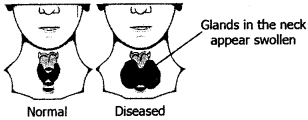
Deficiency of which nutrient is responsible for this bodily condition?
(a) Iodine; it results in goitre
(b) Iron; it results in anaemia
(c) Vitamin C; it results in scurvy
(d) Vitamin B1; it results in beriberi
Answer:
(a) Iodine; it results in goitre
6. The table lists some food items.

Which option correctly indicates a balanced diet?
(a) Samosa, poori, sweets, sweets
(b) Poori, jaggery, banana, cold drinks
(c) Soya bean, sweets, spinach, cold drinks
(d) Spinach, jaggery, banana, soya bean
Answer:
(d) Spinach, jaggery, banana, soya bean
7. The table shows a list of some food items.
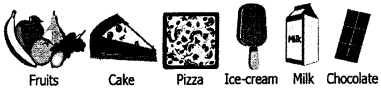
Which of these food items is important to be included in a balanced diet?
(a) Fruits, milk
(b) Cake, fruits
(c) Pizza, chocolate
(d) Ice cream, cake
Answer:
(a) Fruits, milk
8. Which government agency regulates food quality in India?
(a) JSSIA
(b) FSSAI
(c) DAASI
(d) EFSS
Answer:
(b) FSSAI
9. Which of the following is a millet?
(a) Bajra
(b) Soyabean
(c) Kidney Bean
(d) Rice
Answer:
(a) Bajra
10. Which deficiency of a vitamin/mineral causes swelling at the front of the neck?
(a) Vitamin A
(b) Vitamin C
(c) Iron
(d) Iodine
Answer:
(d) Iodine
Case Study Questions
I. Our food contains three main substances called nutrients. The major nutrients in our food are carbohydrates, proteins, fats, vitamins, and minerals. In addition, food also contains dietary fibres and water. Various food components are grouped in three classes:
- Energy-giving food: Carbohydrates and fats
- Bodybuilding food: Proteins
- Protective food: Vitamins and minerals
A balanced diet provides all the nutrients that our body needs, in the right quantities, along with an adequate amount of roughage and water. Deficiency of one or more nutrients in our food for a long time may cause certain diseases or disorders. If a person does not get adequate food or if his/her diet does not contain all the nutrients, he or she becomes weak. When the body does not get adequate nutrition, it is said to be suffering from malnutrition. Food items that are deep-fried and roasted usually lose their nutritional value. The requirement of energy or intake of food depends on profession, age, sex, and special needs like pregnancy, infancy, lactation, etc.
1. The ingredients contain some components that are needed by the body. These components are called nutrients. Which of the following is/are not considered the nutrient component of our food?
(a) Carbohydrates and fats
(b) Minerals and vitamins
(c) Proteins
(d) Roughage
Answer:
Roughage
2. Match the items in column P with those in columns Q and choose the correct option:
| Column P | Column Q |
| (i) Growth and body-building food | A. Fat and Carbohydrates |
| (ii) Protective food | B. Proteins |
| (iii) Energy-giving food | C. Water and Milk |
| (iv) Improves digestion | D. Minerals and Vitamins |
| E. Roughage |
(a) (i) ↔ A, (ii) ↔ B, (iii) ↔ D, (iv) ↔ C
(b) (i) ↔ E, (ii) ↔ D, (iii) ↔ C, (iv) ↔ A
(c) (i) ↔ E, (ii) ↔ B, (iii) ↔ A, (iv) ↔ C
(d) (i) ↔ B, (ii) ↔ D, (iii) ↔ A, (iv) ↔ E
Answer:
(d) (i) ↔ B, (ii) ↔ D, (iii) ↔ A, (iv) ↔ E
3. Match the items in column P with those in columns Q and choose the correct option:
| Column P | Column Q |
| (i) Groundnut and tuar dal | A. Minerals and Vitamins |
| (iii) Sugar and Rice | B. Protein |
| (iii) Apple and Spinach | C. Roughage |
| (iv) Wheat Brown, Oats, Whole Grains | D. Carbohydrate |
(a) (i) ↔ B, (ii) ↔ C, (iii) ↔ D, (iv) ↔ A
(b) (i) ↔ B, (ii) ↔ D, (iii) ↔ A, (iv) ↔ C
(c) (i) ↔ D, (ii) ↔ B, (iii) ↔ A, (iv) ↔ C
(d) (i) ↔ C, (ii) ↔ D, (iii) ↔ A, (iv) ↔ B
Answer:
(b) (i) ↔ B, (ii) ↔ D, (iii) ↔ A, (iv) ↔ C
4. Which of the following statements is incorrect about the vitamins?
(a) Vitamins help in protecting our body against diseases.
(b) Vitamins help in keeping our eyes and gums healthy.
(c) Vitamins help in keeping our bones and teeth healthy.
(d) Wheat and rice are rich sources of vitamins in our diet.
Answer:
(d) Wheat and rice are rich sources of vitamins in our diet.
5. Which of the following is a correct statement describing the definition of a balanced diet?
(a) A diet containing carbohydrate, protein, and fat.
(b) A diet containing carbohydrate, protein, fat, minerals, and vitamins.
(c) A diet containing carbohydrate, protein, fat, minerals, vitamins, and roughage.
(d) A diet containing all components of food, like carbohydrate, protein, fat, minerals, vitamins, roughage, and water in appropriate quantities.
Answer:
(d) A diet containing all components of food, like carbohydrate, protein, fat, minerals, vitamins, roughage, and water in appropriate quantities.
II. In the 1960s, Indian scientists found that among the human population in the Himalayan region and the Northern plains of India, symptoms of swelling at the front of the neck were prevalent. As per the norms of the Government of India, an effort was made to supplement common salt with iodine for preparing iodised salt. Consumption of iodised salt visibly reduced the above symptoms. These symptoms were due to a deficiency of iodine in the soil of this region, resulting in a lack of iodine in the local food and water supply. Swelling at the front of the neck is a symptom of a disease called goitre.
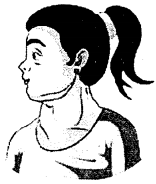
1. Choose the correct symptom of less iodine in the diet.
(a) Swollen arm
(b) Swollen neck (front part)
(c) Problem in the leg
(d) Disability to see
Answer:
(b) Swollen neck (front part)
2. Choose the correct food component with its deficiency disease.
(a) Vitamin A → Scurvy
(b) Vitamin D → Bone and tooth decay
(c) Iron → Anaemia
(d) Calcium → Rickets
Answer:
(c) Iron → Anaemia
3. Which region/s of India have symptoms of swelling at the front of the neck?
(a) Himalayan Region
(b) Northern Region
(c) Southern Region
(d) Both (a) and (b)
Answer:
(d) Both (a) and (b)
4. What is iodised salt?
(a) Simply common salt
(b) Only iodine
(c) Simply common salt + Required quantities of salts of iodine
(d) Common salt + minerals
Answer:
(c) Simply common salt + Required quantities of salts of iodine
5. When we add 2-3 drops of iodine solution to different food items, which food item indicates the presence of starch?
(a) Only protein-rich food items
(b) Fat-rich food items
(c) Mineral-rich food items
(d) Carbohydrate-rich food items
Answer:
(d) Carbohydrate-rich food items