Living Creatures Exploring Their Characteristics Class 6 MCQ
easyLiving Creatures: Exploring Their Characteristics Class 6 MCQ
1. Animals like a camel can survive in a desert. Which of these features in the camel helps them to survive in the desert?
(а) Hump of the camel produces food
(b) A long neck helps to store more water
(c) Long legs protect them from the heat of the sand
(d) Thicker skin helps in the transpiration of more water
Answer:
(c) Long legs protect them from the heat of the sand
2. Animals like polar bears living in cold regions have long hair on their body. How do these hairs help an animal to survive in a cold region?
(a) It keeps their body warm
(b) It helps an animal to run faster
(c) It helps the animal to swim in water
(d) It absorbs water from the atmosphere
Answer:
(a) It keeps their body warm
3. A list of a few abiotic components is provided below.
- Rock
- Soil
- Water
Which of these options correctly differentiates the abundance component in each type of habitat?
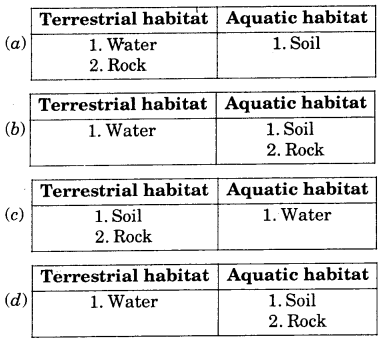
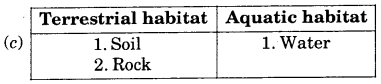
Answer:
4. The image shows a plant that was left near a sunny window unattended for a few weeks.
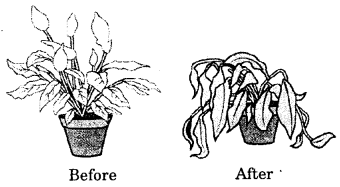
What can be concluded based on the observation?
(a) Water is essential for plants to survive
(b) The presence of water makes the leaf green
(c) Plants grow stronger in the absence of water
(d) Plants can absorb water from the atmosphere
Answer:
(a) Water is essential for plants to survive
5. A student performed an experiment where he planted two similar plants in two different pots. He covered one of them with a carton and placed the other plant close to the window. He provides an equal amount of water to both of them. After 10 days, the growth of the plants is shown in the image.
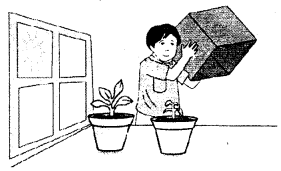
Which of these statements can be concluded based on the activity?
(а) Plants produce their own food
(b) Plants require sunlight to grow
(c) Plants can survive without air and water
(d) Growth of a plant depends only on the water supply
Answer:
(b) Plants require sunlight to grow
6. When a person from the plains visits the mountains for the first time, they experience shortness of breath. This changes over the next few days as a person adapts. What happens in this process of adaptation?
(а) The body undergoes an allergic reaction, which later subsides
(b) The body adjusts its breathing according to the air of the new habitat
(c) The person feels homesickness but later gets used to being away from home
(d) The person gets used to the different flora and fauna of mountain habitats
Answer:
(b) The body adjusts its breathing according to the air of the new habitat
7. A cactus in a desert lacks leaves. Instead of leaves, its thick stem is responsible for photosynthesis. Why are leaves absent in these plants?
(a) Leaves would have wilted easily in the strong desert Sun
(b) Leaves are absent in cactus plants to save them from predators
(c) Leaves would have caused increased loss of water from the plant
(d) Leaves are reduced to spines to protect from cold nights in the desert
Answer:
(c) Leaves would have caused increased loss of water from the plant
8. Snakes do not have protective modifications like Camels and Coyotes to survive under the hot desert Sim for a long time. How are they considered a part of a desert’s biodiversity?
(a) They only reside in a desert wherever there is an oasis
(b) They have a slimy coating, which makes it easier for them to slither
(c) They are nocturnal and mostly stay deep underground during the day
(d) They are less mobile in a desert and feed off whatever is available nearby
Answer:
(c) They are nocturnal and mostly stay deep underground during the day
9. In an aquatic habitat, fish have streamlined bodies and respire underwater through their gills. However, mammals such as dolphins and whales also live in such habitats, but they do not have gills. How can they survive in aquatic habitats alongside fish?
(a) They respire through their skin
(b) They absorb the gases dissolved in the water they consume
(c) They absorb gases through the membranes present in their fins
(d) They hold their breath underwater and come up to breathe air via the nostrils
Answer:
(d) They hold their breath underwater and come up to breathe air via the nostrils
Case Study Questions
I. You all see white patches forming on shirts around the armpits due to sweat in summer. The sweat consists of water and salts removed by the body as waste products. Removal of waste products from the body is called excretion. Urine is also formed as a product of excretion in animals. Do you know that plants also excrete? You may notice plants excrete excess water and minerals in the form of small droplets on leaves. For example, grasses and roses. All living beings excrete.
1. Removal of waste products from the body is called:
(a) respiration
(b) breathing
(c) excretion
(d) None of these
Answer:
(c) excretion
2. What is the main way plants excrete waste?
(a) Through roots
(b) Through stems
(c) Through leaves
(d) Through transpiration
Answer:
(c) Through leaves
3. Which of the following is an example of excretion in plants?
(а) Absorption of water
(b) Release of oxygen
(c) Release of carbon dioxide
(d) Release of water vapour
Answer:
(d) Release of water vapour
4. Which pores on the leaves are helpful for the exchange of gases?
(a) Stomata
(b) Veins
(c) Midrib
(d) Lamina
Answer:
(a) Stomata
5. What are the raw materials for the food preparation of leaves?
(a) Water
(b) Air
(c) Sunlight
(d) All of these
Answer:
(d) All of these
II. Some seeds of flowering plants, like Coleus and Petunia, require light to germinate. Covering these seeds with soil inhibits their sprouting. Seeds of flowering plants, like Calendula and Zinnia, need darkness to germinate. These seeds should be covered with sufficient soil.
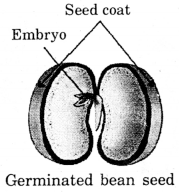
1. Which flowering plants require light to germinate?
(a) Coleus
(b) Petunia
(c) Jasmine
(d) Both (a) and (b)
Answer:
(d) Both (a) and (b)
2. Name the seed given here.
(a) Moong dal
(b) Bean
(c) Masoor
(d) Kidney bean
Answer:
(b) Bean
3. What makes the tiny embryo inside it develop into a plant?
(a) Air
(b) Heat
(c) Water
(d) Dark conditions
Answer:
(c) Water