Measurement of Length and Motion Class 6 Short Question Answer
hardMeasurement of Length and Motion Class 6 Short Question Answer
Measurement of Length and Motion Class 6 Short Question Answer
Question 1.
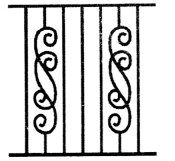
The photograph given as figure shows a section of a grille made up of straight and curved iron bars. How would you measure the length of the bars of this section, so that the payment could be made to the contractor ?
Answer:
The length can be measured using a thread which can be further measured with the help of a scale.
Question 2.
While travelling in a train, it appears that the trees near the track are moving whereas co-passengers appear to be stationary. Explain the reason.
Answer:
When we see the trees from a moving train, their position is changing with respect to us. Hence they appear to be moving. On the other hand the position of co-passengers is not changing with respect to us, hence they appear to be stationary.
Question 3.
How are the motions of a wheel of a moving bicycle and a mark on the blade of a moving electric fan different? Explain.
Answer:
The wheel of a moving bicycle depicts circular as well as rectilinear motion whereas a blade of a moving electric fan shows only circular motion.
Question 4.
What is the need for standard units ?
Answer:
The non-standard units like cubit, foot, etc. varies from person to person. This creates confusion in measurement. Hence, a standard unit which is same for everyone is needed.
Question 5.
Identify; the type of motion in the following examples :
(а) Motion of a child on a swing.
(b) March past of a soldier in a parade.
Answer:
(a) Periodic molion
(b) Straight-line motion
Question 6.
Write one example for each of the following type of motion.
- Rectilinear
- Circular
- Periodic
- Circular and periodic
Answer:
- An object moving on a straight road, falling stone, etc.
- A mark on blades of a rotating fan, tips of the hands of a clock, etc.
- Motion of a child on a swung, motion of pendulum, strings of a guitar, etc.
- Blades of a rotating fan, hands of a clock, etc.
Question 7.
Three students measured the length of a corridor and reported their measurements. The values of their measurements were different. What could be the reason for difference in their measurements?
Answer:
Some of the reasons for difference in their measurement could be:
- Different measuring devices were used.
- The smallest length that could be measured by different devices may be different.
- Measurement may not be along the shortest length in all three cases.
- The end of the corridor may not be easily accessible.
- The measuring devices may be faulty (not standardised) (any three)
Question 8.
How does the sewing machine show circular motion and the periodic motion simultaneously ?
Answer:
When sewing machine is operated, it remains at the same location while its wheel moves with a circular motion. It also has a needle that moves up and down continuously, as long as the wheel rotates. This needle is undergoing a periodic motion.
Question 9.
How is the result of measurement expressed ?
Answer:
The result of a measurement is expressed in two parts. One part is a number. The other part is the unit of the measurement. The number shows how many times the unit is equal to the quantity to be measured. For example, the length of a room is equal to 4 times of metre scale then its length is 4 metres.