Measurement of Length and Motion Class 6 MCQ
easyMeasurement of Length and Motion Class 6 MCQ
1. The image shows the bullock cart used in villages to transport materials from one place to another.
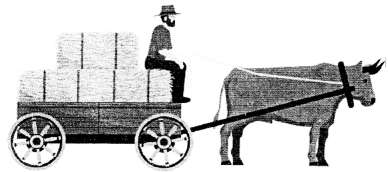
What change to the cart would best increase the vehicle's efficiency?
(a) Use of the engine instead of the bulls
(b) Use of a greater number of drivers
(c) By increasing the number of wheels
(d) Attaching a greater number of wheels to the cart
Answer:
(a) Use of the engine instead of the bulls
2. The evolution of modes of transport is shown in the image.
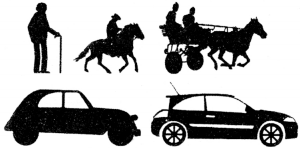
What factor is largely responsible for the evolution of transportation?
(а) The size of the vehicle
(b) Use of animals for pulling
(c) Use of wheels in the vehicle
(d) The number of people driving the vehicle
Answer:
(c) Use of wheels in the vehicle
3. A student wants to measure the length of the room. The student has various materials shown in the table.

What object can be chosen to measure the length of the room?
(a) A pen
(b) A 15 cm ruler
(c) Piece of thread
(d) Long wooden rod
Answer:
(b) A 15 cm ruler
4. A student wants to measure the length of the fencing of a garden. The student has a long wooden rod and a 30 cm ruler. What can the student do to easily measure the length of the fencing?
(a) Measure the length of the fencing using foot steps
(b) Find the number of rod lengths required for the length of the fencing
(c) Measure the length of the fencing using a hand span, and then measure the length of a hand span using the 30 cm ruler
(d) Measure the length of the rod using the 30 cm ruler, then find the number of rod lengths required for the length of the fencing
Answer:
(d) Measure the length of the rod using the 30 cm ruler, then find the number of rod lengths required for the length of the fencing
5. Two students measure the length of a window using their hand spans. The table shows the length of the window as reported by each student.
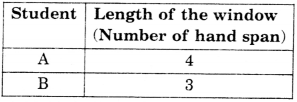
Why is the length reported by the students different?
(а) Because the length of the hand span of A is greater than that of B
(b) Because the length of the hand span of B is greater than that of A
(c) Because measuring with a hand span requires an external device
(d) Because the measurement with the hand span needs further calculation
Answer:
(b) Because the length of the hand span of B is greater than that of A
6. A student measures the length of the pencil using a broken ruler. The image shows the measurement by the broken ruler.
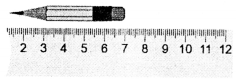
The student made an error and recorded the length of the pencil as 7 cm. How can this error be removed?
(a) By measuring with the hand span
(b) By adding the initial and final reading
(c) By measuring the length from the end of the ruler
(d) By subtracting the initial reading from the final reading
Answer:
(d) By subtracting the initial reading from the final reading
7. A student developed a two-dimensional map using a globe. Every 10 cm distance on the globe is represented by 5 cm distance on the map.
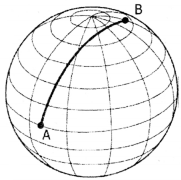
If the distance between the two points A and B on the globe is 30 cm, what would be the distance between A and B on the map?
(a) 5 cm
(b) 15 cm
(c) 30 cm
(d) 60 cm
Answer:
(b) 15 cm
8. The table shows the position of two balls, A and B, at different times.
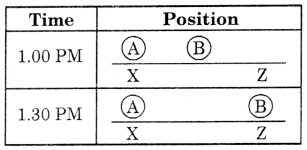
According to the given observation, which option defines the motion of the two balls?
(a) Both Ball A and Ball B were in motion
(b) Both Ball A and Ball B remain at rest
(c) Ball A was in motion, and Ball B remains at rest
(d) Ball B was in motion, and Ball A remains at rest
Answer:
(d) Ball B was in motion, and Ball A remains at rest
9. When distance is stated with respect to a fixed object or point, then this point is called:
(a) origin point
(b) variable point
(c) reference point
(d) None of these
Answer:
(c) reference point
Case Study Questions
I. Units of length, such as kilometre, metre, centimetre, and millimetre, begin with a lowercase letter, except at the beginning of a sentence. Their symbols km, m, cm, and mm are also written in lowercase letters, and are never followed by ‘s’ for the plural. Note that a full stop is not written after the symbol, except at the end of a sentence. While writing the length, always leave a space between the number and the unit.
1. Length cannot be measured in:
(a) kilometre
(b) centimetre
(c) metre
(d) kilogram
Answer:
(d) kilogram
2. Which of the following is the correct unit for measuring length in the metric system?
(a) kg
(b) metre
(c) litre
(d) handspan
Answer:
(b) metre
3. If a pencil is 15 cm long, how many mm is it?
(a) 15 mm
(b) 150 mm
(c) 1,500 mm
(d) 0.15 mm
Answer:
(b) 150 mm
4. Which tool would you use to measure the length of a piece of cloth?
(a) Ruler
(b) Stopwatch
(c) Compass
(d) Thermometer
Answer:
(a) Ruler
5. What unit would be best to measure the height of a person?
(a) mm
(b) metres
(c) km
(d) litres
Answer:
(b) metres
II. If an object repeats its path after a fixed interval of time, its motion is said to be periodic. When an object is in circular motion, it moves along the circular path again and again. An object in oscillatory motion also repeats its motion while moving to and fro. Both circular and oscillatory motions are periodic in nature.
1. What type of motion does the pendulum exhibit?
(a) Circular motion
(b) Linear motion
(c) Oscillatory motion
(d) Rotational motion
Answer:
(c) Oscillatory motion
2. What type of motion is the car experiencing as it moves around the roundabout?
(a) Linear motion
(b) Oscillatory motion
(c) Circular motion
(d) Random motion
Answer:
(c) Circular motion
3. Which of the following is NOT an example of oscillatory motion?
(а) A fork vibrating
(b) A rock falling from a height
(c) A pendulum swinging
(d) A spring bobbing up and down
Answer:
(b) A rock falling from a height
4. What type of motion does a clock’s second hand exhibit?
(a) Oscillatory motion
(b) Linear motion
(c) Circular motion
(d) Rotational motion
Answer:
(c) Circular motion