Methods of Separation in Everyday Life Class 6 MCQ
easyMethods of Separation in Everyday Life Class 6 MCQ
1. The image shows the process of winnowing.
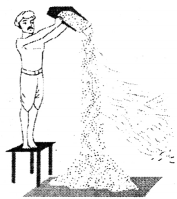
Based on what property does the mixture get separated in winnowing?
(a) Size
(b) Shape
(c) Colour
(d) Weight
Answer:
(d) Weight
2. The image shows the two types of marbles in the jar.
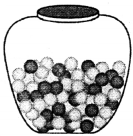
Based on what property can the marbles be separated?
(a) based on size
(b) based on colour
(c) based on shape
(d) based on weight
Answer:
(b) based on colour
3. A sample of flour has unground wheat grains mixed in it. Which method can be used to separate the wheat grains from the flour?
(a) Sieving
(b) Filtration
(c) Threshing
(d) Sedimentation
Answer:
(a) Sieving
4. While making the tea, which method of separation is used to separate the tea leaves?
(a) Filtration
(b) Evaporation
(c) Decantation
(d) Sedimentation
Answer:
(a) Filtration
5. A student has a solution of sand and water. What method can be used to separate sand from the water easily?
(а) Mix a chemical in the solution
(b) Place the solution in the sunlight
(c) Stir the solution and leave the heater undisturbed
(d) Pour the solution into another beaker using a sieve
Answer:
(d) Pour the solution into another beaker using a sieve
6. The table shows the materials required for a filtration process.
- A beaker
- A funnel
- Filter paper
How should these materials be arranged to separate the insoluble material from water?
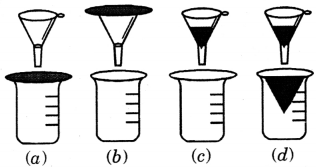
Answer:
(c)
7. A bag has the limes and oranges. A student separates them by the method of handpicking without looking inside the bag directly. Why do you think the student uses the method of handpicking in this case?
(a) Because both fruits have different sizes
(b) Because both fruits have different colours
(c) Because both fruits have different shapes
(d) Because both the fruits have different weights
Answer:
(a) Because both fruits have different sizes
8. A student heated a saltwater solution to obtain the salt from the solution. Why did the student heat the salt water solution?
(a) Because salt evaporates easily
(b) Because salt is soluble in water
(c) Because salt is lighter and comes to the surface
(d) Because salt settles at the bottom in water
Answer:
(b) Because salt is soluble in water
9. Grain and husk can be separated with the process of:
(a) sedimentation
(b) winnowing
(c) decantation
(d) filtration
Answer:
(b) winnowing
10. The process of settling down to a heavier insoluble component at the bottom of a liquid is called:
(a) decantation
(b) sieving
(c) sedimentation
(d) filtration
Answer:
(c) sedimentation
Case Study Questions
I. Substances need to be separated from each other to remove impurities or to get two or more useful products. There are various methods for separating substances, such as handpicking, threshing, winnowing, sieving, sedimentation, decantation, and filtration, etc. In sieving and filtration, the difference in the size of particles in a mixture is utilised to separate them. Husk is separated from the heavier seeds of grain by winnowing. From a mixture of sand and water, the heavier sand particles settle down at the bottom, and the water can be separated by decantation. To separate the components of a mixture of an insoluble solid and a liquid, filtration can be used. Evaporation is the process in which a liquid converts into its vapour. It can be used to separate a solid dissolved in a liquid. A saturated solution is one in which no more quantity of that substance can be dissolved at a fixed temperature.
1. Match the items in column P with those in columns Q and choose the correct option:
| Column P | Column Q |
| (i) Difference in the size of particles in a mixture of two solids | A. Filtration |
| (ii) Heavier sand particles settle down at the bottom | B. Winnowing |
| (iii) Mixture of chalk powder and water | C. Sieving |
| (iv) Husk and grains | D. Decantation |
(a) (i) ↔ A, (ii) ↔ B, (iii) ↔ D, (iv) ↔ C
(b) (i) ↔ C, (ii) ↔ D, (iii) ↔ A, (iv) ↔ B
(c) (i) ↔ D, (ii) ↔ B, (iii) ↔ A, (iv) ↔ C
(d) (i) ↔ B, (ii) ↔ C, (iii) ↔ D, (iv) ↔ A
Answer:
(b) (i) ↔ C, (ii) ↔ D, (iii) ↔ A, (iv) ↔ B
2. Which of the following is a method of separating butter from milk?
(a) Decantation
(b) Churning
(c) Filtration
(d) Sedimentation
Answer:
(b) Churning
3. The process of conversion of water vapour into liquid is:
(a) Evaporation
(b) Sedimentation
(c) Decantation
(d) Condensation
Answer:
(d) Condensation
4. Which of the following statements is incorrect?
(a) Sieving can be used for separating a mixture of wheat grains and iron fillings of the same size.
(b) A mixture of wheat grains and husk can be separated by winnowing.
(c) Salt can be separated from a solution of salt and water by evaporation.
(d) A mixture of oil and water can be separated by decantation.
Answer:
(a) Sieving can be used for separating a mixture of wheat grains and iron fillings of the same size.
5. A mixture of salt, sand, and water can be separated by using:
(a) Decantation and filtration only.
(b) Filtration and condensation only.
(c) Decantation, condensation, and sedimentation only.
(d) Decantation, filtration, evaporation, and condensation.
Answer:
(d) Decantation, filtration, evaporation, and condensation.
II. In a science experiment, Maya mixed a bowl of sand, salt, and water. She wanted to separate these substances to use them again. First, she used a sieve to separate the sand from the mixture. Since the sand particles were larger than the salt, they got caught in the sieve, while the salt and water mixture passed through. Next, Maya decided to separate the salt from the salty water. She poured the salty water into a shallow dish and placed it in a sunny spot. Over time, the water evaporated due to the heat from the sun, leaving behind the salt crystals in the dish. Maya used these methods to successfully separate and recover the sand, salt, and water.
1. What method did Maya use to separate the sand from the mixture?
(a) Filtration
(b) Decantation
(c) Sieving
(d) Evaporation
Answer:
(c) Sieving
Explanation: Maya used a sieve to separate the sand from the mixture. Sifting or sieving is used to separate larger particles (sand) from smaller particles (salt and water).
2. Why was the sieve effective in separating the sand from the mixture?
(a) Because sand dissolves in water, while salt does not.
(b) Because the sieve has holes that are smaller than the sand particles.
(c) Because the sieve allows the salt and water to pass through, leaving the sand behind.
(d) Because the sand and salt are both heavier than water.
Answer:
(c) Because the sieve allows the salt and water to pass through, leaving the sand behind.
Explanation: The sieve separates the sand from the mixture by retaining the larger sand particles and allowing the smaller particles (salt and water) to pass through.
3. What process did Maya use to separate the salt from the salty water?
(a) Decantation
(b) Filtration
(c) Evaporation
(d) Magnetic separation
Answer:
(c) Evaporation
Explanation: Maya used evaporation by placing the salty water in a dish and letting it sit in the sun, allowing the water to evaporate and leaving the salt crystals behind.
4. What is the main principle behind the method Maya used to separate salt from water?
(a) Separating based on the size of particles.
(b) Separating based on density.
(c) Separating based on solubility and evaporation.
(d) Separating based on magnetic properties.
Answer:
(c) Separating based on solubility and evaporation.
Explanation: The principle behind evaporation is to separate a soluble substance (salt) from a liquid (water) by removing the liquid through evaporation.
5. Which separation technique would you use to recover sand from a mixture of sand and salt if you didn’t have a sieve?
(a) Filtration
(b) Decantation
(c) Evaporation
(d) Manual picking
Answer:
(b) Decantation
Explanation: Decantation is the process of separating sand from the solution of salt and water. The solution of salt and water is removed from the top, leaving the layer of solid below.