Find the area of the quadrilateral ABCD given that AC = 22 cm, BM = 3 cm, DN = 3 cm, BM is perpendicular to AC, and DN is perpendicular to AC. Class 8
easyFind the area of the quadrilateral ABCD given that AC = 22 cm, BM = 3 cm, DN = 3 cm, BM is perpendicular to AC, and DN is perpendicular to AC. Class 8
Question 1.
Find the area of the quadrilateral ABCD given that AC = 22 cm, BM = 3 cm, DN = 3 cm, BM is perpendicular to AC, and DN is perpendicular to AC. Class 8
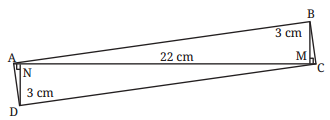
Solution:
Area of quadrilateral ABCD = Area of ∆ABC + Area of ∆ACD
= [latex]\frac{1}{2}[/latex] AC × BM + [latex]\frac{1}{2}[/latex] AC × DN.
= [latex]\frac{1}{2}[/latex] × 22 × 3 + [latex]\frac{1}{2}[/latex] × 22 × 3 = 22 × 3
= 66 sq cm.
Question 2.
Find the area of the shaded region given that ABCD is a rectangle. Class 8
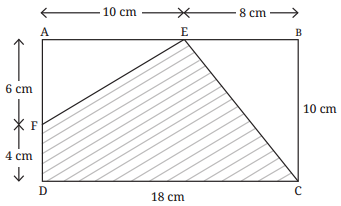
Solution:
Area of rectangle ABCD
= AB × BC
= 18 × 10 = 180 sq. cm.
Area of ∆AEF = [latex]\frac{1}{2}[/latex] AE × AF
= [latex]\frac{1}{2}[/latex] 10 × 6 = 30 sq. cm.
and area of ∆EBC = [latex]\frac{1}{2}[/latex] EB × BC
= [latex]\frac{1}{2}[/latex] × 8 × 10 = 40 sq. cm.
So, area of shaded region
= Area of ABCD - Area of AEF - Area of EBC
= (180 - 30 - 40) sq. cm.
= 110 sq. cm.