Parallel and Intersecting Lines Class 7 Notes
hardParallel and Intersecting Lines Class 7 Notes
Parallel and Intersecting Lines Class 7 Notes
Lines
Intersecting lines
Perpendicular lines
Angle between the lines is 90°
Intersect at one point Linear pair
Vertically opposite angles are equal
Parallel Lines
Do not intersect at any point
Drawing Parallel Lines
By paper folding
By using the properties of the pairs of angles with the help of set squares
Transversal
A transversal intersecting parallel lines
Corresponding angles are equal
Alternate angles are equal
Sum of the interior angles on the same side of the transversal is 180°
A line intersecting two or more lines at distinct points
A transversal intersecting two lines form eight angles
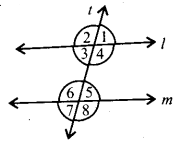
Corresponding angles
Alternate angles
Interior angles on the same side of the transversal
CHAPTER AT A GLANCE
Important Terms and Their Meanings Understanding Plane Surfaces
- A plane surface is a flat, two-dimensional surface like a table top or a piece of paper.
- Lines drawn on a plane can either intersect or run parallel.
1. Parallel Lines:
Definition : Parallel lines are a pair of lines that lie in the same plane and do not intersect, no matter how far they are extended in either direction.
Example : The edges of a ruler or the lines on a notebook page.
2. Transversal:
Definition : A transversal is a line that intersects two or more other lines at distinct points.
Example : If line t crosses lines l and m, then t is the transversal.
3. Corresponding Angles:
Definition : Corresponding angles are pairs of angles that are in the same position at each intersection where a transversal crosses two lines.
Example : If ∠a is formed by line l and transversal t, and ∠b is formed by line m and transversal t, then ∠a and ∠b are corresponding angles.
4. Alternate Angles:
Definition : Alternate angles are pairs of angles that are on opposite sides of the transversal and inside the two lines.
Example: If ∠f is on one side of the transversal and ∠d is on the opposite side, then ∠d is the alternate angle of ∠f.
5. Vertically Opposite Angles :
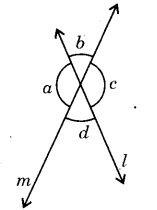
Intersecting Lines and Angles
- When two lines intersect, they meet at a point and form four angles. Lines (l) and (m) intersect at a point, creating four angles ∠a, ∠b, ∠c and ∠d.
- The angles opposite each other are called vertically opposite angles and are always equal. Angle ∠a and ∠c are vertically opposite and are equal.
6. Linear Pairs of Angles
- A linear pair consists of two adjacent angles whose non-common sides form a straight line.
- The sum of the angles in a linear pair is always 180°.
- In the figure above ∠a and ∠b are a linear pair and add up to 180°.
Main Components of Parallel and Intersecting Lines
1. Identification of Parallel Lines : To determine if two lines are parallel, one can check if the corresponding angles formed by a transversal are equal. For example, if ∠a is equal to ∠f, then lines l and m are parallel.
Identifying Parallel Lines
- Parallel lines are marked with arrow symbols in diagrams.
- Real-world example : The lines on a ruled notebook page are parallel.
2. Use of Transversals : Transversals play a crucial role in establishing relationships between angles. By analyzing the angles formed when a transversal intersects two lines, one can derive various angle relationships (corresponding, alternate, and interior angles on the same size of the transversal).
3. Angle Relationships : Understanding the relationships between angles is key to solving problems involving parallel and intersecting lines. For instance :
- If two parallel lines are cut by a transversal, the alternate angles are equal.
- The sum of the interior angles on the same side of the transversal is 180°.
4. Proofs and Justifications : In geometry, proofs are essential for establishing the validity of statements regarding parallel and intersecting lines. For example, proving that vertically opposite angles are equal involves demonstrating that they are formed by the intersection of two lines.
Perpendicular Lines
Perpendicular Lines : Perpendicular lines intersect at right angles (90°).
When two lines are perpendicular, they create four angles at the point of intersection, and all four angles will be equal to 90°.
Transversals
A transversal is a line that intersects two or more other lines at distinct points. When a transversal crosses two lines, it creates several angles at the points of intersection.
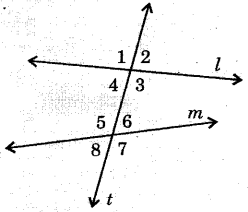
When line t intersects lines l and m. This intersection creates eight angles, winch we can label as follows : ..
- Angles formed at the intersection with line (l): (∠1, ∠2, ∠3, ∠4)
- Angles formed at the intersection with line (m): (∠5, ∠6, ∠7, ∠8)
Corresponding Angles
Corresponding angles formed by a transversal intersecting a pair of parallel lines are always equal to each other.
Also converse,
When the corresponding angles formed by a transversal on a pair of lines are equal to each other, then the pair of lines are parallel to each other.