Quadrilaterals Class 8 Notes
mediumQuadrilaterals Class 8 Notes
Quadrilaterals Class 8 Notes
Quadrilaterals
A quadrilateral is a polygon with :
4 sides
4 vertices (comers)
4 angles
The sum of the interior angles is always 360° :
∠A + ∠B + ∠C + ∠D = 360°
Properties of Quadrilaterals Angles :
The sum of all angles in a quadrilateral' is always 360°.
Diagonals : In rectangles and squares, diagonals are equal and bisect each other.
Sides : In rhombuses and squares, all sides are equal.
Types of Quadrilaterals Rectangles
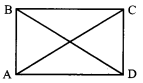
A rectangle is a special quadrilateral with :
All angles equal to 90°
Opposite sides equal: If one side is (a), the
opposite side is also (a); if another side is (b),
the opposite side is also (b).
Opposite sides are parallel:
(AB || CD) and (AD || BC).
Diagonals are equal: (AC = BD).
Diagonals bisect each other : They cut each
other in half at the midpoint.
Squares
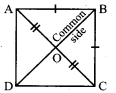
A square is a special type of rectangle with :
All sides equal: (AB = BC = CD = DA = s).
All angles equal to 90°.
Opposite sides are parallel.
Diagonals are equal: (AC = BD).
Diagonals bisect each other at right angles (90°).
Diagonals bisect the angles : Each angle is divided into two (45°) angles.
Parallelograms
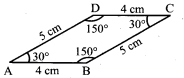
A parallelogram has :
Both pairs of opposite sides parallel.
Opposite sides are equal:
(AB = CD) and (AD = BC).
Opposite angles are equal:
(∠A = ∠C) and (∠B = ∠D).
Consecutive angles are supplementary : (∠A + ∠B = 180°).
Diagonals bisect each other.
Rhombus
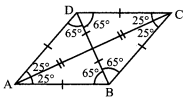
A rhombus is a type of parallelogram with :
All sides equal.
Opposite sides are parallel.
Adjacent angles add up to 180°.
Diagonals bisect each other at right angles.
Diagonals bisect the angles.
Trapezium (Trapezoid)
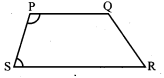
A trapezium has :
At least one pair of parallel sides.
Sum of interior angles is always 360°.
Angles on the same side of a transversal are supplementary: (∠P + ∠S = 180°).
Isosceles Trapezium
A special trapezium where:
Non-parallel sides are equal.
Angles opposite the equal sides are equal. Sum of angles is 360°.
Has a line of symmetry.
Angles in a Quadrilateral
A quadrilateral is a polygon with four sides, four vertices, and four angles. One of the fundamental properties of quadrilaterals is the sum of their interior angles.
Sum of Angles : When we draw a diagonal in a quadrilateral, it divides the shape into two triangles. For example, consider a quadrilateral labeled as (ABCD). If we draw a diagonal (AC), we create two triangles : (∆ABC) and (∆ACD).
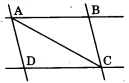
The sum of the angles in a triangle is always (180°). Therefore, for our two triangles, we can write :
- For (∆ABC): [∠A + ∠B + ∠C = 180° ]
- For (∆ACD): [∠A + ∠C + ∠D = 180° ]
If we add these two equations together, we get: [∠A + ∠B + ∠C ) + (∠A + ∠C + ∠D) = 180° + 180°]
This simplifies to:
[2∠A + 2∠C + ∠B + ∠D = 360°]
However, since (∠A) and (∠C) are counted twice, we can conclude that :
[∠A + ∠B + ∠C + ∠D = 360°]
Thus, the sum of the interior angles of any quadrilateral is always (360°). This property helps us understand why it’s impossible to have a quadrilateral with three right angles (each (90°)) and a fourth angle that is not a right angle. If three angles are (90°), the fourth angle must also be (90°) to satisfy the total of (360°).
More Quadrilaterals with Parallel Opposite Sides
Now, let’s explore quadrilaterals that have parallel opposite sides.
Parallelograms : A parallelogram is a special type of quadrilateral where both pairs of opposite sides are parallel. This means that if one side is extended, it will never meet the opposite side.
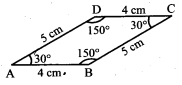
Properties of Parallelograms:
- Opposite Sides are Equal : In a parallelogram, the lengths of opposite sides are equal. For example, if (ABCD) is a parallelogram, then (AB = CD) and (AD = BC).
- Opposite Angles are Equal : The angles opposite each other in a parallelogram are equal. So, (∠A = ∠C) and (∠B = ∠D).
- Consecutive Angles are Supplementary: The angles that are next to each other (consecutive angles) add up to (180°). For instance, (∠A + ∠B = 180°).
- Diagonals Bisect Each Other : The diagonals of a parallelogram bisect each other, meaning that they cut each other in half. If (AC) and (BD) are the diagonals, then the point where they intersect divides them into two equal parts.
Examples of Parallelograms
- Rectangle : A rectangle is a special type of parallelogram where all angles are (90°).
- Rhombus : A rhombus is another type of parallelogram where all sides are of equal length, but the angles are not necessarily (90°).
Quadrilaterals with Equal Sidelengths
When we talk about quadrilaterals with equal sidelengths, we are referring to shapes where all four sides are of the same length. The most well- known example of such a quadrilateral is a rhombus. However, it is important to note that squares are not the only quadrilaterals with equal sidelengths.
To understand this concept, let’s consider how we can construct a quadrilateral with equal sides. Imagine we draw two equal sides, say (AD) and (AB), which are not perpendicular to each other. Next, we can find a point (C) such that the distances from (B) and (D) to (C) are equal to the length of (AB) (or (AD)). This can be done using a compass to measure the length and cutting arcs from points (B) and (D).
By doing this, We can create a quadrilateral (ABCD) where all sides (AB), (BC), (CD), and (DA) are equal. This quadrilateral can have any angle less than (180°), and it will still maintain equal sidelengths.
Rhombus : A rhombus is a special type of quadrilateral where all four sides are of equal length. It is also a type of parallelogram, which means that its opposite sides are parallel.
Properties of a Rhombus
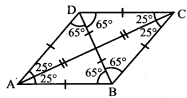
- Equal Sides : All four sides of a rhombus are equal in length. This is the defining property of a rhombus.
- Parallel Opposite Sides : The opposite sides of a rhombus are parallel to each other, just like in any parallelogram.
- Adjacent Angles : The adjacent angles of a rhombus add up to (180°). This means that if one angle is (50°), the adjacent angle will be (130°) (since (180 - 50 = 130)).
- Equal Opposite Angles : The opposite angles in a rhombus are equal. For example, if (∠A = 50°), then (∠C) will also be (50°), while (∠B) and (∠D) will each be (130°).
- Diagonals Bisect Each Other : The diagonals of a rhombus bisect each other at right angles (90 degrees). This means that they cut each other in half.
- Diagonals Bisect Angles: The diagonals of a rhombus also bisect the angles of the rhombus. This means that each diagonal divides the angles into two equal parts.
Playing with Quadrilaterals
A geoboard or dot grid paper Activity
Instructions:
- Creating a Square : Place two rubber bands on the geoboard so that they intersect at right angles (90°) and are of equal length.
- Connect the ends of the rubber bands to form a quadrilateral.
- Creating a Rectangle : Place two rubber bands on the geoboard so that they intersect at right angles (90°) and extend one of the diagonals by 2 cm on both sides than other band length.
Connect the ends of the rubber bands to form a quadrilateral.
What is a Trapezium?
A trapezium (also known as a trapezoid in some regions) is a type of quadrilateral that has at least one pair of opposite sides that are parallel.
This means that in a trapezium, you can have two sides that run alongside each other without ever meeting, while the other two sides can be of any length and orientation.
Visual Representation:
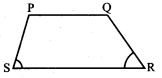
In this example, the sides PQ and RS are parallel, making PQRS a trapezium.
Properties of a Trapezium
- At least one pair of parallel sides: This is the defining property of a trapezium.
- Sum of interior angles : The sum of the angles in any quadrilateral, including trapeziums, is always (360°).
- Angles on the same side of a transversal:
If two sides of a trapezium are parallel, then the angles on the same side of a transversal (the line that crosses the two parallel lines) are supplementary. This means that they add up to (180°).
∠P + ∠S = 180°
For example, if PQ is parallel to RS, then :
-∠P + ∠S = 180°
-∠Q + ∠R = 180°
Isosceles Trapezium : If the non-parallel sides (the legs) of a trapezium are equal in length, it is called an isosceles trapezium. In an isosceles trapezium, the angles opposite the equal sides are also equal.
What is an Isosceles Trapezium?
An isosceles trapezium is a special type of trapezium where the non-parallel sides are of equal length. This symmetry gives it some unique properties.
Properties of an Isosceles Trapezium :
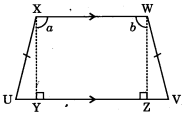
- Equal non-parallel sides : The lengths of the non-parallel sides (legs) are equal. For example, if you have trapezium (UVWX) with (UV || XW), then (UX = VW).
- Equal angles : The angles opposite the equal sides are equal. For instance, if (∠U) and (∠V) are opposite the equal sides (UX) and (VW), then : ∠U = ∠V.
- Sum of angles : As with all trapeziums, the sum of the angles in an isosceles trapezium is (360°).
- Symmetry : An isosceles trapezium has a line of symmetry that runs down the middle from the top base to the bottom base, dividing it into two mirror-image halves.