The following table shows the retail price (in ₹) of iodised salt in the month of January in a few states over 10 years. Class 8
easyThe following table shows the retail price (in ₹) of iodised salt in the month of January in a few states over 10 years. Class 8
Question 1.
The following table shows the retail price (in ₹) of iodised salt in the month of January in a few states over 10 years. For your calculations and plotting you may round off values to the nearest counting number. Class 8
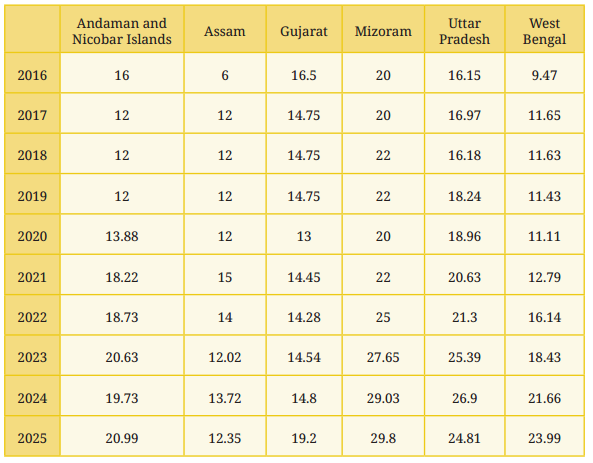
(i) Choose data from any 3 states you find interesting and present it through a line graph using an appropriate scale.
(ii) What do you find interesting in this data? Share your observations.
(iii) Compare the price variation in Gujarat and Uttar Pradesh.
(iv) In which state has the price increased the most from 2016 to 2025?
(v) What are you curious to explore further?
Solution:
(i) Do as directed
(ii) Do as directed.
(iii) Price variation in Uttar Pradesh is more in comparison to Gujarat.
(iv) West Bengal.
(v) Regarding the prices of salt in other states as well as the price variations of the other essentials in the country.
Question 2.
Referring to the graph below, which of the following statements are valid? Why? Class 8
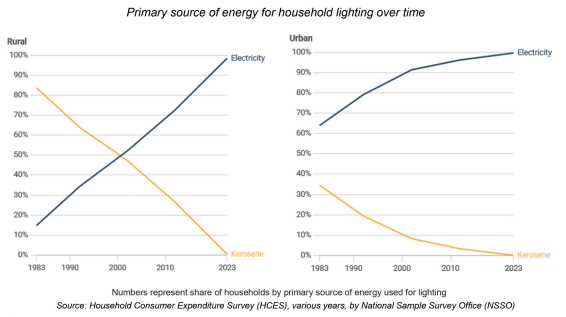
(i) In 1983, the majority in rural areas used kerosene as a primary lighting source while the majority in urban areas used electricity.
(ii) The use of kerosene as a primary lighting source has decreased over time in both rural and urban areas.
(iii) In the year 2000, 10% of the urban households used electricity as a primary lighting source.
(iv) In 2023, there were no power cuts.
Solution:
(i) Valid as 80% of rural areas were using kerosene and 60% of urban areas were using electricity.
(ii) Valid, which is depicted by the decreasing trends of the graphs.
(iii) Not valid, as according to graph, it is 90%.
(iv) Valid as shown the continuous graphs.