Exploring Magnets Class 6 Short Question Answer
hardExploring Magnets Class 6 Short Question Answer
Exploring Magnets Class 6 Short Question Answer
Question 1.
Four identical iron bars were dipped in a heap of iron filings one by one. Figure shows the amount of iron filings sticking to each of them.
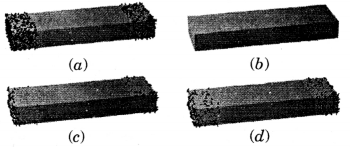
(a) Which of the iron bar is likely to be the strongest magnet?
(b) Which of the iron bars is not a magnet? Justify your answer.
Answer:
(a) 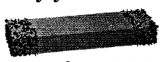
(b) B because there are no iron filings sticking to it.
Question 2.
A toy car has a bar magnet laid hidden inside its body along its length. Using another magnet how will you find out which pole of the magnet is facing the front of the car?
Answer:
If the front of the toy car gets attracted to the north pole of the given magnet then it is the south pole of the bar magnet hidden inside the car.
Question 3.
You are provided with two identical metal bars. One out of the two is a magnet. Suggest two ways to identify the magnet.
Answer:
- By suspending the metal bars
- By attracting iron filings
- Using another magnet
Question 4.
What are non-magnetic materials ? Give examples.
Answer:
Materials which do not get attracted towards a magnet, are called non-magnetic materials. Water, plastic, wood, etc. are examples of non-magnetic materials.
Question 5.
How do magnets lose their properties?
Answer:
- Hammering on magnet loses their magnetism.
- Dumping or falling on the ground.
- By strong heating the magnet also loses its magnetism.
Question 6.
Three identical iron bars are kept on a table. Two out of three bars are magnets. In one of the magnet the North-South poles are marked. How will you find out which of the other two bars is a magnet? Identify the poles of this magnet.
Answer:
The magnet with known poles will attract and repeat two ends of a magnet and attend both the end of an ordinary bar. (Test for repulsion)
Question 7.
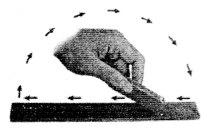
Describe the steps involved in magnetising an iron strip with the help of a magnet.
Answer:
By rubbing the iron with a magnet as shown in the figure below.
Question 8.
Suggest an activity to prepare a magnetic compass by using an iron needle and a bar magnet.
Answer:
Magnetise the needle and set it in a way that it may rotate freely suspend it.
Question 9.
Boojho kept a magnet close to an ordinary iron bar. He observed that the iron bar attracts a pin as shown in the figure.

What inference could he draw from this observation? Explain.
Answer:
The magnetic properties are induced into the iron bar and it acts like a magnet till the magnet is kept near it.
Question 10.
Draw a diagram to show the way iron filings stick to the magnet.
Answer:
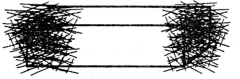
Fig. Iron fillings sticking to a bar magnet