If the length of a rectangle is increased by 10% and the area is unchanged, by what percentage (exactly) does the breadth decrease by? Class 8
mediumIf the length of a rectangle is increased by 10% and the area is unchanged, by what percentage (exactly) does the breadth decrease by? Class 8
Question 1.
If the length of a rectangle is increased by 10% and the area is unchanged, by what percentage (exactly) does the breadth decrease by? Class 8
Solution:
Let length and breadth be x and y respectively.
So, area = xy.
Let decrease percentage in breadth of d.
So. new area = x × [latex]\frac{110}{100}[/latex] × y ×[latex]\frac{(100-d)}{100} [/latex]
Therefore, xy × [latex]\frac{110}{100}[/latex] × [latex]\frac{(100-d)}{100}[/latex] = xy
or 110 (100 - d) = 10000
or 11000 - 110d = 10000
or 110d = 11000 - 10000
or 110d = 1000
So, d = [latex]\frac{1000}{110}[/latex]
= [latex]\frac{100}{11}[/latex] = 9[latex]\frac{1}{111}[/latex]%
Question 2.
The percentage of ingredients in a 65 g chips packet is shown in the picture. Find out the weight each ingredient makes up in this packet. Class 8
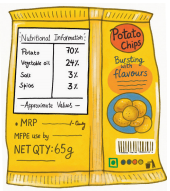
Solution:
Weight of potato
= 70% of 65 g
= [latex]\frac{70}{100}[/latex] × 65 g = 45.5 g
Weight of vegetable oil
= 24% of 65 g
= [latex]\frac{24}{100}[/latex] × 65 g = 15.6 g
Weight of salt = 3% of 65 g
= [latex]\frac{3}{100}[/latex] × 65 g = 1.95 g.
Weight of spices = 3% of 65
= [latex]\frac{3}{100}[/latex] × 65 g = 1.95 g.